A book by Ralph Schwehr
Minimal Seed
Deciding when there is no second chance
A narrative non-fiction book about decisions under scarcity. The onboard AI KORE carries 41 kilograms of seeds on a 300-year journey to Proxima b. Whatever she decides on the way, she can no longer correct.
The book and the idea
One decision per chapter
Each chapter tells a decision KORE can make only once: what comes along, what stays dormant, when to harvest. Each one comes with the calculation behind it, a case from my work as an interim manager and a tool you can use the next day.
All calculations are based on the KORE mission model. It is published in full in the book's appendix, so every decision can be recalculated. The book is written in German, an English edition will follow.
Guiding questionHow do you make a good decision when you can no longer correct it?
What is real and what is not
The book separates three levels and labels them. So does this page.
- Level of knowledge: FactReal physics and mathematics, backed by sources in the book.
- Level of knowledge: ModelResult of the KORE mission model, following published rules.
- Level of knowledge: FictionSet assumptions: mission, life forms, disruption rates and plot.
The journey at a glance
300 years on an energy source that keeps fading
- Level of knowledge: FactThe energy on board comes from plutonium-238, whose output halves every 87.7 years.
- Level of knowledge: ModelBelow 470 watts it no longer covers demanding calculations. Anything that needs a lot of computing has to be decided before then.
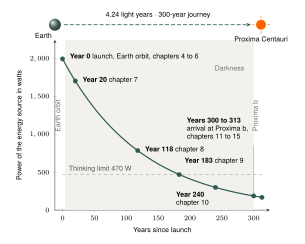
Image description
Line chart. The horizontal axis shows years since launch from 0 to 313, the vertical axis the power of the energy source in watts up to 2,000. The curve falls steadily from 2,000 watts in year 0 to 168 watts in year 313. A dashed line marks the thinking limit at 470 watts, which the curve reaches in year 183. Dots on the curve show when the chapters take place: year 0, launch in Earth orbit, chapters 4 to 6. Year 20, chapter 7. Year 118, chapter 8. Year 183, chapter 9. Year 240, chapter 10. Years 300 to 313, arrival at Proxima b, chapters 11 to 15. A grey area from year 4 to 300 stands for the darkness. Above it, a dashed arrow runs from Earth to Proxima Centauri: 4.24 light years, a 300-year journey.
Structure
Five parts

Part I · Chapters 1 to 3
Packing
Kiruna, before launch. 41 kilograms of seeds, twelve storage compartments, six archetypes and the question of what comes along.

Part II · Chapters 4 to 6
The last light
Three years in Earth orbit with plenty of sunlight. What grows and gets stored now has to last through the darkness.

Part III · Chapters 7 to 10
The darkness
296 years without sunlight. Energy shrinks, the seeds age, and Earth is too far away to help.

Part IV · Chapters 11 to 13
Strange light
Arrival at Proxima b. A red star, a planet with a day side and a night side, and the question of where to land.
Part V · Chapters 14 and 15
The first harvest
Years 304 to 313 on Proxima b. What the mission was built for.
Decisions from the book
Each sketch explains one decision
Four examples from parts I to IV.
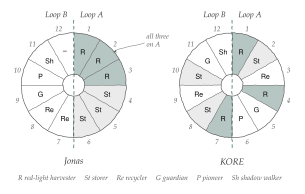
Image description
Two round storage modules seen from above, each with twelve compartments. The right half is on loop A (compartments 1 to 6), the left half on loop B (7 to 12). Left, Jonas's layout: all three red-light harvesters sit side by side on loop A in compartments 1 to 3, next to three compartments of storers. Loop B holds two recyclers, a guardian, a pioneer and a shadow walker, one compartment stays empty. Right, KORE's layout: the three red-light harvesters sit in compartments 1, 4 and 7, so they are on both loops. Storers, recyclers and guardians are spread across both sides as well, plus one pioneer and one shadow walker.
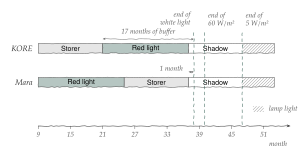
Image description
Timeline from month 9 to 53 with two bars, KORE above and Mara below. Both split the time into sections for storer, red light and shadow, followed by a hatched section of lamp light. KORE starts with the storer and finishes it in month 21, then red light until month 37, then shadow. Mara starts with red light until month 25, then storer until month 37, then shadow. Dashed lines mark three limits: end of white light at month 38, end of 60 W/m² at month 40, end of 5 W/m² at month 47. KORE keeps a 17-month buffer between the storer and the end of white light, Mara keeps 1 month.
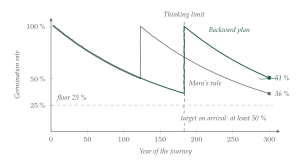
Image description
Line chart of germination rate over the years of the journey from 0 to 300. Both plans start at 100 percent and fall in the same way at first. Mara's rule (grey) jumps back to 100 percent around year 123 and ends at 36 percent on arrival. The backward plan (green) waits until the thinking limit in year 183, drops to just under 40 percent by then, jumps to 100 percent and ends at 51 percent. A dashed line marks the floor of 25 percent. The target on arrival is at least 50 percent.
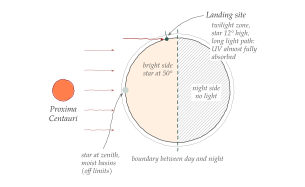
Image description
Cross-section of the planet Proxima b. The star Proxima Centauri sits on the left, its light coming in from the left. The bright side is shaded warm, with the star at 50 degrees. The right half is hatched: night side, no light. A dashed line marks the boundary between day and night. Where the star stands at the zenith there are moist basins, marked as off limits. The landing site sits at the top in the twilight zone near the day-night boundary. There the star is 12 degrees high, the light takes a long path through the atmosphere, and UV is almost fully absorbed.
Author
Ralph Schwehr
Ralph Schwehr has worked in digital business for almost 30 years, around 20 of them in leadership roles. He makes decisions where resources are scarce and mistakes are expensive. He led digital business at PAYBACK, REWE Group and Bechtle, built new business units and steered companies through restructurings. Today he is CEO and Chief AI Officer of OAKAI and sits on the supervisory board of Elsen International. He holds an M.Sc. in Business Informatics, completed the Data Science Program, Harvard University, HarvardX, and trains language models himself. He lives in Munich.